
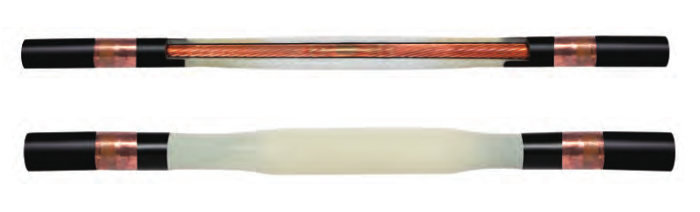
Fusion joint (straight-through) DH-RZJ-U0/U1×□□□mm2
Fusion joint (straight-through) DH-RZJ-U0/U3×□□□mm2
8.7/15kV;12/20 kV;18/30 kV;26/35 kV;27.5/48 kV
1、The electric field distribution pattern and electrical stability at cable joint is decided by formation and equi-potential distribution of electric field in the fusion joint and cable, and the structural form of cable joint. The distribution pattern and intensity of the electric field in the cable shows a uniform and stable trend, and the electric field strength distributes uniformly when the inner shield layer is at a high potential state relative to the insulation. It is based on this principle that the structure, materials and manufacturing process of fusion joint are designed.
2、The fusion joint is bonded to cable insulation based on molecular permeation, and fabricated with the same material as cable, offering higher stability in terms of chemical and physical properties, the inherent cable material and electric performance. The fusion joint restores the inherent cable structure, achieves all electrical and physical properties of the original cable.
3、Conductors are bonded with exothermic welding process, and the soldering point is of the same diameter, low resistance and high strength, permanently aging resistant, can undergo failure current surge and long-term large-current operation to ensure durable and reliable electrical connection. Good tensile strength ensures that bending of the joint will have no influence on electrical stability.
4、Based on the principle of electric field stress control design, the structure, specifications and materials of the conductor shielding layer and the external shielding layer of the bonded cable are fabricated to achieve a continuous and equivalent electric field distribution in the joint and the cable.
5、In the design of cable insulation performance, the same XLPE as the cable insulation is used to bonded the insulation of joint with that of cable without air gap in the fusion section to form an integral junction consistent to the cable in structure without visible soldering point, achieving the same dielectric strength as original cable, higher electrical isolation and better durability in stable operation.
1、Electric field stress control: Based on the structure, specifications and materials of the conductor shielding layer and the external shielding layer of the bonded cable are fabricated to achieve a continuous and equivalent electric field distribution in the joint and the cable.
2、Insulation performance: The same XLPE restoration as the cable insulation is used to melt and bond the joint insulation with the cable insulation without air gap section, structurally forming a full junction consistent with cable without visible joint appearance, offering the same dielectric strength as original cable, higher electrical isolation and better durability in stable operation.
3、Water resistance: On-site layered fusion and seamless bonding of the inner and external semi-conductive layers, insulation layers and the cable itself to ensure excellent water resistance.
4、Dimensions: The fusion joint is made in the diameter close or equal to the outer diameter of cable, at any special position where the cable bends or hangs vertically at high altitude, without taking up too much space in the joint well.
5、Conductor connection: Conductors are bonded with exothermic welding process, and the soldering point is of the same diameter, low resistance and high strength, permanently aging resistant, can undergo failure current surge and long-term large-current operation to ensure durable and reliable electrical connection.
6、Mechanical strength: Copper conductors are fused and bonded together, and the repaired cable is bendable and there is no need to worry about the impact of cable dragging.